
It’s about 5 pm in Jerusalem, an hour before the fast officially ends. But I chose to end my fast early this year. I have taken a cup of Nescafe and a few honey cookies to the garden across the street from where Uzi and Esti live and where Kevin and I have been staying. When I arrive one man draped in a talit is sitting on a bench and he watches me take my coffee to another bench, book in hand. He leaves minutes later and I am alone in the small neighborhood park with a sandbox and a few benches. The light is on it’s way out and there seem to be an endless number of birds hovering above. The city is quiet, but for these birds. I listen and watch them fly overhead. Usually the break fast feels incredibly anticlimactic. You have waited more than 24 hours to finally put something in your mouth, but by the time you do, the desire is gone, the routine has already been broken, and there is no way of gaining what you have lost. [Read more →]
Break fast
October 15th, 2008 by Michal · Uncategorized
→ 1 CommentTags:
The Art of War
October 3rd, 2008 by Michal · Uncategorized
Here is the latest piece I wrote for the Forward.
Two years ago, in the midst of the Second Lebanon War, the popular French philosopher Bernard-Henri Lévy was sent to Israel by The New York Times Magazine to “ponder, discuss and travel,” as the title of his piece suggested. The result, an essay defending the country’s military action against vociferous critics, was published alongside two photographs by the still relatively unknown Israeli photographer Shai Kremer, who had also been sent by the Times. One photo showed a helicopter about to land, with a flock of birds trailing at its tail. The other featured a soldier atop a tank on duty near the border with Lebanon, with large, white ammunition shells piled on the soil and a distant view of a cemetery.
In August 2006, most readers were probably unfamiliar with Kremer’s work. But Kremer’s reputation was already growing. At the time, the photographer was immersed in a seven-year project documenting the effects of war on Israel’s landscape. His subjects ranged from abandoned military outposts, borders and barriers to nature reserves dotted with military detritus. That collection, Infected Landscape, recently published in art-book format by Dewi Lewis Publishing in Manchester, England, was released to American and European markets last month. To mark its release, a selection of photographs is on display at several galleries around Israel.
The pairing of Levy and Kremer was an interesting choice, given that their views on the war could not have been more different: One launched a verbal defense, while the other sought to present a visual counterpoint. But that’s exactly what photography editor Kathy Ryan had in mind when she paired the two, Kremer told the Forward in a recent interview. “I don’t want to speak in her name, but I believe she looked for a visual opinion that would somehow balance the words of Bernard-Henri Lévy,” Kremer said.
Comments Off on The Art of WarTags:
Jewish Wedding Masala
September 28th, 2008 by Kevin · Uncategorized
Recently, Ulf, Gabriela, Michal, and I went to a wedding of Gabriela’s first cousin’s son, Daniel, which would make him Michal’s second cousin. For Israelis, the wedding probably just blended into some of the approximately 2000 that they go to in the course of an Israeli lifetime. For me, however, it was a small peek into the masala – the diversity and mixture – that makes up Israeli society.
Comments Off on Jewish Wedding MasalaTags:
Class Genius
September 9th, 2008 by Kevin · Uncategorized
Yesterday was my first day of Ulpan (language class) at Ulpan Gordon. I was told to come in the morning for the placement test, and when I arrived I joined the teeming masses of seekers of Hebrew knowledge, and was given an exam to assess my reading and writing skills. Needless to say, they’re rather limited, but not so limited to place me in a complete beginner’s class. However, as the examinatrix informed me, there wasn’t a great placement available for me in the evening classes, but if I wanted I could join the beginner’s class which had started last week and be the “class genius.”
I decided to go for genius status (I take it where I can) and start from aleph bet. So last night I showed up for class expecting to sit next to Adam, Rebecca, and Lisa. But instead, it was Muhammad, Ming, Lu Tau, and Paola. In fact, I appeared to be in the seemingly paradoxical situation of being one of the few Jews taking a course in Hebrew language. My colleagues were a motley crew of workers, refugees, diplomats and others from around the world who were in Israel for a variety of reasons, many as of yet to be determined. Sitting next to me, for example, was a woman from Brazil that came from a town I had never heard of. When I asked her what brought her to Israel (in my rudimentary but comparatively brilliant Hebrew) she pointed to the gold ring on her finger. She married a guy named Moishe, and now she’s in Tel Aviv. Go figure. There was also Muhammad, a refugee from Sudan (I’d definitely like to talk to him about his story), a Philipina worker, a young Thai hipster, and a pale faced chain smoking Swede, to name but a few.
And then there was the Chinese guy in the back of the class who was trying to challenge my status as class genius. When I entered he was chatting away on the phone in Hebrew, causing a student in front of him to nervously enquire out loud if this was indeed the beginner’s class. And when Rachel, our teacher, would ask the class, for example, “eizeh yom hayom?” (what day is it today), perhaps reflecting China’s aspirations for dominant world status he would yell out loud before anyone else had a chance, “hayom yom sheni!” (today is Monday). Rachel felt compelled to tell him to slow down a little so as not to make the other students feel bad. Then, sharing a cultural lesson about proud Jewish mothers to the Israel newcomers, she informed him that her daughter spoke fluent Chinese and had spent a year in university in Taipei. So there.
→ 2 CommentsTags:
Yaffo on a Saturday Night
September 7th, 2008 by Michal · Uncategorized
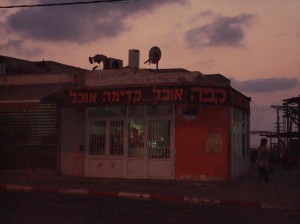
The name of this cafe is : “Coffee, Food…Come on, Food”
(It reminds me a bit of the Little Engine that Could.)
Comments Off on Yaffo on a Saturday NightTags:
Images on the way to Yaffo
September 7th, 2008 by Michal · Uncategorized
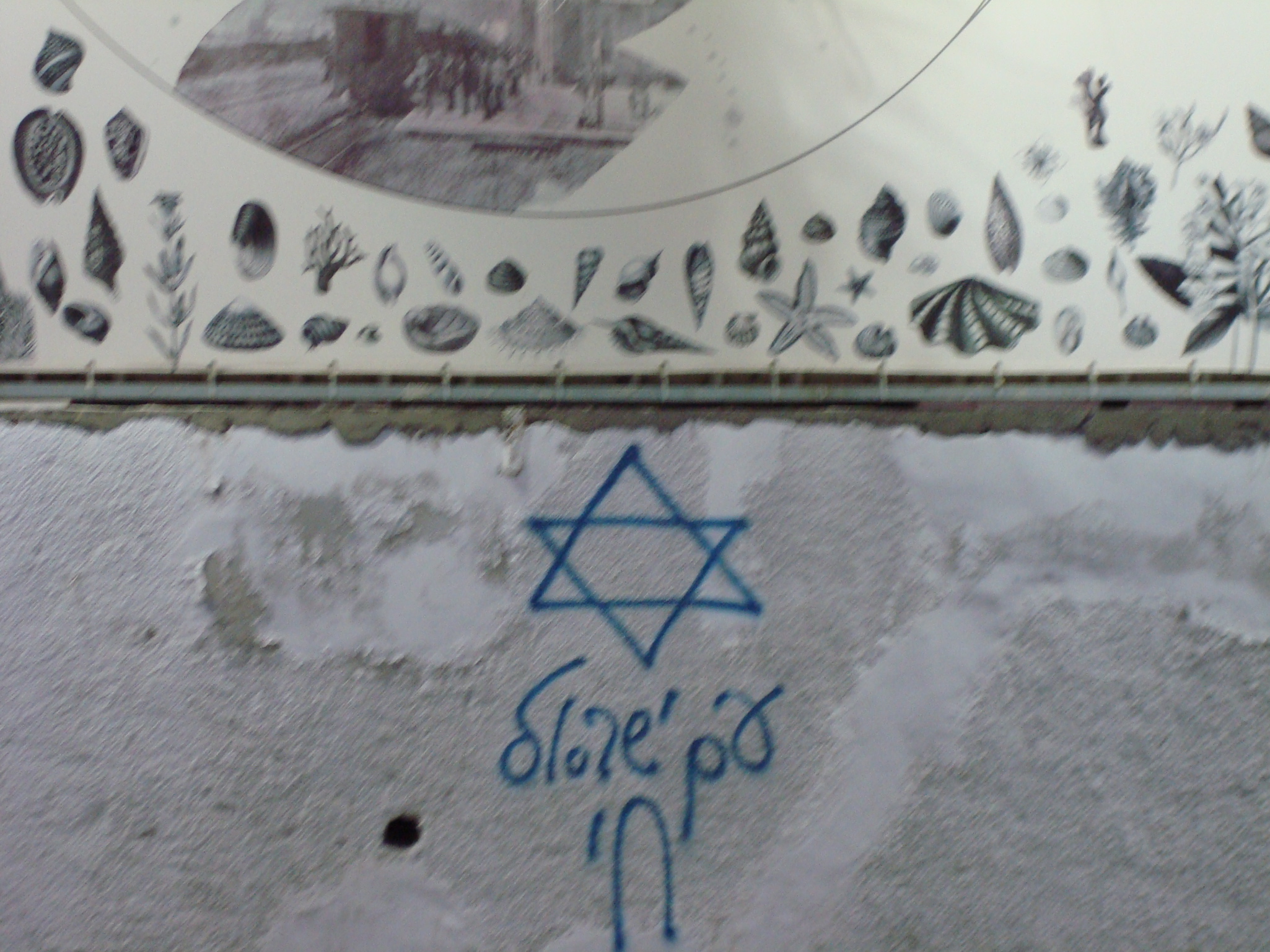
 Street graffiti is one way of getting to know a country and Israel’s wall art is no exception. It reflects a country that is self-reflecting, deeply irreverant, and often despairing; a country divided and torn about how they see themselves and the world outside. The lower image features one of the country’s most popular street symbols that has laid the groundworks for an existential conversation among Israel’s graffiti artists. The phrase, taken from an old song, means “The people of Israel lives,” and has long been a patriotic anthem. But for years graffiti artists have distorted the phrase, turning “chai,” which means “life,” into other words such as “chayot,” meaning “animals,” such that the phrase reads “The people of Israel are animals,” or “The people of Israel live in a dream,” (Am Israel chai be’chalom) one of my favorite variations on the theme.
→ 1 CommentTags:
Paul Auster “Man In the Dark”
September 5th, 2008 by Michal · Uncategorized

 Here’s my latest review:
http://www.jpost.com/servlet/Satellite?cid=1220526711485&pagename=JPost%2FJPArticle%2FShowFull
Comments Off on Paul Auster “Man In the Dark”Tags:
Bikini Trouble
September 3rd, 2008 by Michal · Uncategorized
 During the month of August days are better spent inside. But at night, when the heat dies down a bit, Jerusalem is lovely. Devorah and I walked from her place on Mendele Mocher Sefarim Street (where I have been staying on and off for the last two weeks) to the German Colony, and on our way back we came in from the backside of the hotel that sits right across the street from her apartment. From the back it looked as if the hotel might have a pool, which tempted us to peek inside. We decided to investigate, but something about us must have looked suspicious, cause we immediately caught the attention of the security outside the hotel. (It may have been because we were the only ones “immodestly” dressed—everyone staying there looked religious as sadly most of this city has become). Inside we went snooping. We took the elevator up and down determined to find a pool that maybe we could sneak in to.
When Devorah moved in to her apartment on Mendele Street, her grandmother was pleased. “It’s good that you are near all the hotels, that way if you need to use the bathroom you can always go,” she said. Why Devorah would need to use a hotel bathroom when her apartment is right there, Devorah didn’t quite understand. But when our snooping landed us in the hotel’s bathroom, Devorah decided to nonetheless try it out, just in case. On our way back up, a hotel employee joined us in the elevator. Our snooping hadn’t resulted in any discoveries, so we decided to flat out ask her whether the hotel has a pool. “No,” she said. “But I see you are already wearing a bathing suit,” she smirked, pointing at me very suspiciously. As some of you know I have been wearing a bikini top as a bra on and off for the last few months. This happened to be the wrong night to be wearing it. I awkwardly tried to explain that I was wearing it as a bra, but given that we were looking for a pool and clearly weren’t guests, I don’t think she quite bought it. For now it seems Devorah will have to stick to her own bathroom after all, and I don’t quite see swimming in her near future.
Comments Off on Bikini TroubleTags:
A Very Fishy Situation
September 1st, 2008 by Kevin · Uncategorized
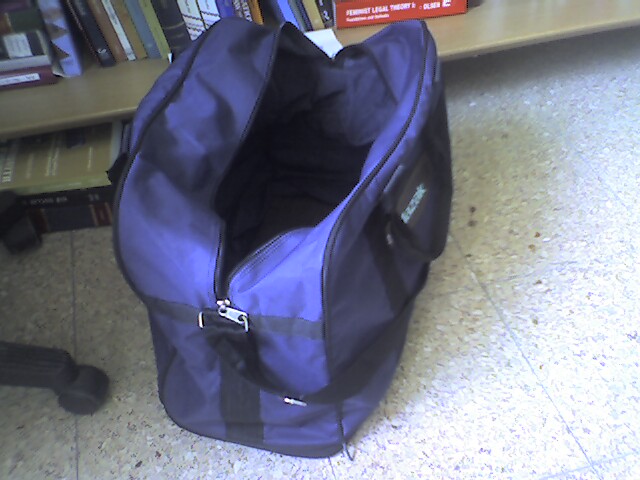 On Friday I returned to Tel Aviv after 17 hours or so of traveling through four different airports – Dhaka – Doha, Doha – Amman, Amman – Tel Aviv. It’s not easy to get places in the Muslim world directly from Israel, or the other way around. I brought two bags with me – one suitcase, and a blue nylon bag that I had bought in Bangladesh in which I had packed all the papers and books that I collected for the labor assessment.
Today I went to my office at the Tel Aviv University Law School, bringing with me the blue nylon bag that I hadn’t opened since I arrived back in Israel. As I started unpacking it, I was startled to see something that was not supposed to be there – a very suspicious looking small packet wrapped in white paper with some Bengali writing on it and sealed by orange tape. It looked like a drug packet right out of central casting. I immediately called Yofi who was in her office, and she came down to take a look at it and exclaimed “oh my god.”
Yofi’s brother in law is a Tel Aviv police detective, and she summoned him to the law school to take a look. He came right over, and using a plastic baggy picked it up to inspect it. He confirmed that it smelled a little odd. Wrapping it in a plastic bag, he carried it out of the building with Yofi and myself in tow. Fortunately, he talked his colleagues out of evacuating the building, which would have been the usual procedure, and which would also have been a rather inauspicious start to my visiting professorship. He brought it just outside of one of the entrance gates of the university, which was promptly closed to all traffic, and called in the police van.
Yofi and I were told to leave the crime scene while the cops investigated the parcel. Campus security, handguns at the ready, came to ensure nobody could enter or exit, one of them informing the stubborn and agitated Israelis who demanded to know what was going on that the gates were closed because “there was a photo shoot going on of playboy models.”
After about 30 minutes of police investigating, we were informed that a thorough analysis revealed that the packet was not filled with cocaine, heroine, or hash – but rather hundreds of small dried Bengali fish. Nevertheless, official procedure required that the package be blown up to ensure that it really wasn’t a bomb in piscine disguise. The area was cleared out, and after the police issued a warning, there was a loud explosion, spreading Bengali fish dust throughout the Tel Aviv University campus.
How that odd parcel made it into my bag, however, remains a mystery. Was it a message from someone or some entity, or perhaps just a friendly parting gift from some good hearted Bangladeshis who thought hummus and dried fish would make a delicious culinary combination?
→ 1 CommentTags:
In Bangladesh
August 25th, 2008 by Kevin · Uncategorized
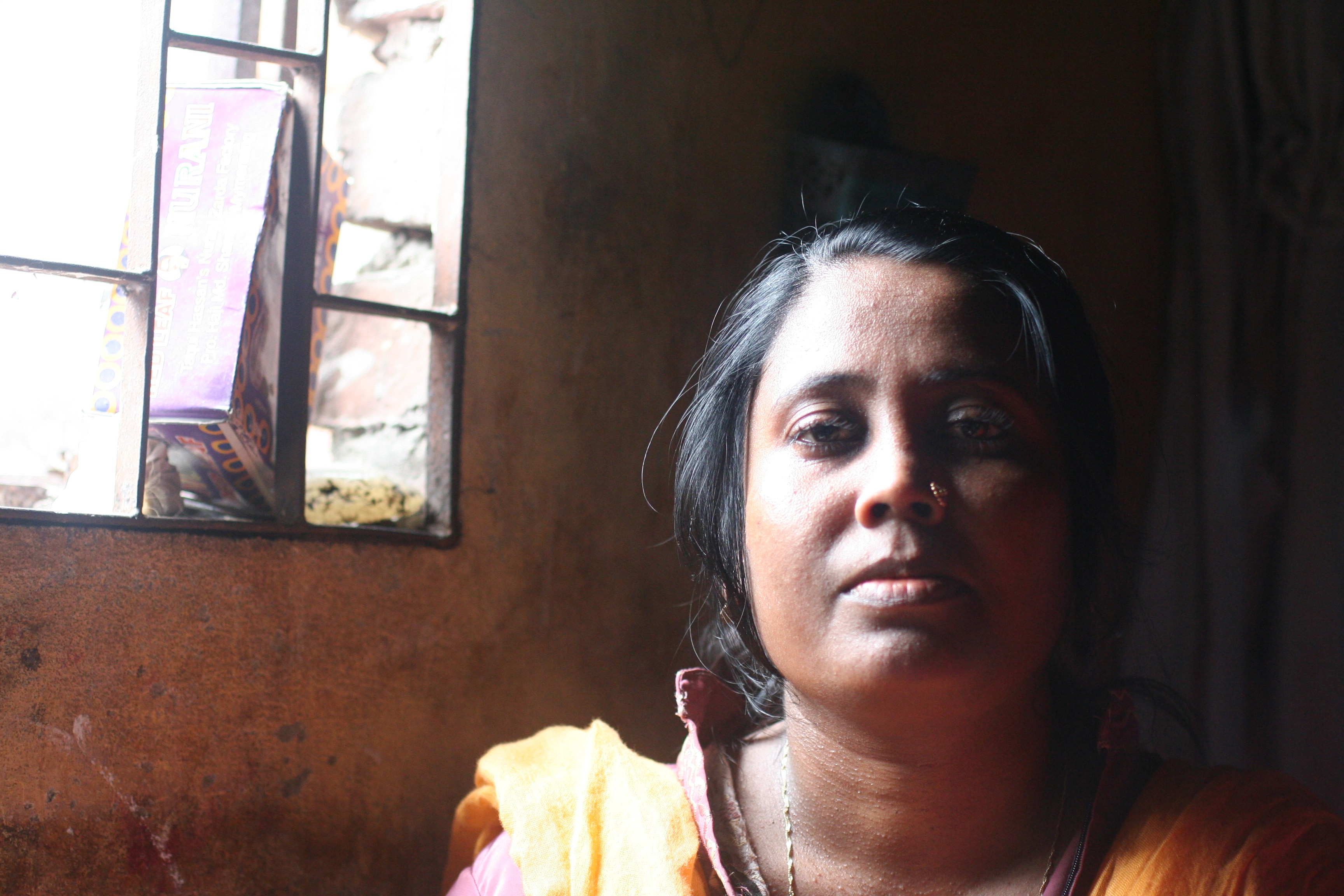 This debut post is being typed from Dhaka, the capital of Bangladesh, where I have been for the last 9 days conducting a labor assessment for USAID, the American government’s development agency. Our specific task is somewhat technical, but I have been visiting with many organizations and people, including groups of workers, many of whom are women.I have visited shrimp processing plant workers in their slum houses, garment workers organizing unions in Dhaka, and rural women who work on shrimp farms in their villages. I have posted some photos of these women at www.kevinkolben.com/photos, and have included one photo here.
But the most moving visit for me happened last night, when I spent a couple of hours with an amazing group of garment workers in the southern port town of Chittagong. To reach the meeting point, we walked along the street of a Chittagong slum, which was bordered on one side by workers houses – the waste of which drained out onto the other side of the street – a river of wretched smelling sewage. We turned into a small dark alley, and entered the tiny shared residence of a group of workers. Taking off my shoes, I walked down a dimly lit, narrow hall. On my left were small rooms, and we were led to another small room, about 7 by 8 feet or so. The room was shared by four people. A married couple rented the room for about $20/month, which is a little less than the minimum wage for a garment worker. The couple slept on a bed, which took up about half the room, and two girls paid them rent to sleep on the floor next to the bed, separated only by a curtain. We sat on the bed, and about 20 girls crowded into the room and sat on the floor around us.
Because of the living conditions and close proximity, rates of TB and STDs are high, and the unmarried girls are sometimes sexually abused by the husbands living in the space. They spend long days at work, leaving at seven for work and returning 12 hours later. Their salaries generally max out at about 2700-3000 Taka with overtime, which is about $40/month – not so much even for Bangladesh. A 15 year old girl, but who looked younger, told us that she used fake age documentation to get a job in a shoe manufacturing facility. In the middle of our conversation the electricty went out, a common occurrence here, and a few of the women picked up hand held fans and used them to keep the sweaty visitors cool. Like so many workers I’ve visited with in many places around the world, this group had a remarkable spirit and sense of community despite the adversity, and they were incredibly gracious to invite us into their home. And when we asked them what they would like to do if they could do anything, they imagined working together as a group, doing embroidery, having their own business, exercising autonomy over their lives.
Comments Off on In BangladeshTags: